Connecticut Lawn Care Calendar: What Your Lawn & Landscape Need Every Month
By David, Owner of David's Landscaping · Farmington, CT · Updated October 2026
The secret to a thick, green, weed-free lawn and clean landscape beds in Connecticut isn't a product. It's timing. Put pre-emergent down two weeks late and crabgrass wins for the whole summer. Seed in June and the new grass cooks. Mulch too early and the beds stay cold. Mulch too late and you're paying to pull weeds first. This Connecticut lawn care calendar is the same schedule we follow on properties across Farmington, Avon, West Hartford, Simsbury and the rest of the Farmington Valley. It covers what your lawn, beds and shrubs need each season and each month, plus a full breakdown of what a lawn fertilization and weed control program should be doing all year.
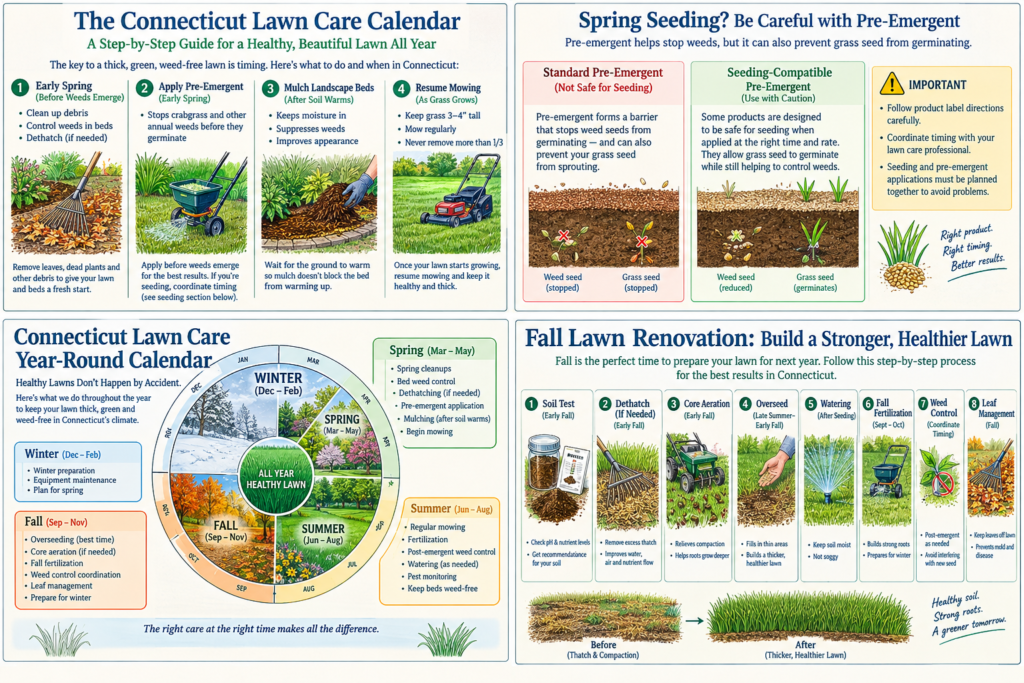
- Early March: bed weed control, spring cleanup and dethatching, before weeds start growing.
- Mid-March to April: lawn pre-emergent goes down before crabgrass germinates, around forsythia bloom.
- Seeding in spring? Coordinate with your pre-emergent, or it can stop your grass seed too.
- April to May: mulch once the soil warms, but before the weeds come up.
- May to October: mow at 3 to 3.5 inches, never removing more than a third of the blade.
- Mid-August to September: the best window in Connecticut to aerate and overseed.
- Mid-October to early December: keep leaves off the lawn. Three to four weeks under wet leaves can kill grass.
The Connecticut Lawn Care Schedule at a Glance
Here's the whole year on one chart. Green is the work our crews do: cleanups, beds, mulch, mowing, trimming, aeration and seeding. Blue is the lawn fertilization and lawn weed control done by a licensed lawn care company. We coordinate that work with our licensed partner, so both schedules fit together.
Why Soil Temperature Beats the Calendar
Connecticut springs vary a lot. Some years the ground is workable in early March, and other years there's snow on the beds in April. That's why professionals schedule by soil temperature and plant cues, not fixed dates:
- Crabgrass germinates after several days of soil temperatures around 55–60°F. In Connecticut, that's usually after forsythia blooms and before lilacs and dogwoods bloom.
- Pre-emergent has to be down before that happens, so forsythia in bloom is your reminder that the window is open.
- Cool-season grass seed germinates best with soil in the 50s and 60s and air temperatures in the 60s and 70s. That's why late summer to early fall is Connecticut's prime seeding season.
- Mulch goes down after the soil has warmed, so it doesn't insulate cold soil and slow the beds down.
Early Spring: March to Mid-April
Early spring is the most important stretch of the year, because almost everything you do now prevents work later. We start our season in early March, as soon as the snow is gone and the ground is firm, and we get ahead of the weeds before they start growing.
Our early-March sequence
- Weed control for beds: the first of our four bed applications goes down before weed seeds sprout, and any early weeds are removed roots and all.
- Dethatching (if needed): done first, so the loosened thatch gets blown into piles and hauled away with the cleanup debris.
- Spring cleanup: leaves, sticks and winter debris removed, perennials and ornamental grasses cut back, beds cleaned out and spade-edged, everything hauled away.
- Wait for the soil to warm, then go straight into mulching (see the next section).
Lawn pre-emergent: before the weeds grow
Crabgrass and other annual grassy weeds sprout from seed every spring. A pre-emergent forms a barrier in the top layer of soil that stops those seeds from establishing. It has to be applied before the weeds germinate, typically mid-March to mid-April in central Connecticut, around forsythia bloom. Once crabgrass is up, a pre-emergent won't touch it. You're left with post-emergent treatments and a summer of patchy lawn. Pre-emergent should be applied by you or by a licensed lawn care company. We coordinate timing with our licensed partner for customers who want it handled.
Also in early spring
- Soil test. Send a sample to the UConn Soil Nutrient Analysis Laboratory every few years. Most Connecticut lawns do best with a pH around 6.0–7.0, and many need lime to get there.
- Walk the lawn for snow mold (matted gray or pink patches), vole runways and salt damage along driveways and walks. Lightly rake matted areas.
- Don't mow yet. Wait until the grass is actively growing, usually late April into May.
- Book early. Spring schedules fill fast.
When to Mulch Landscape Beds in Connecticut
We like every property mulched before the weeds start to grow. Once weeds are up, they have to be pulled before mulch goes down, which adds labor and cost. But we also wait for the ground to warm up, because a thick layer of mulch on cold soil acts like a blanket and keeps the bed from warming properly in spring. In most years that sweet spot falls in April into May.
- Depth: about 3 inches on bare beds, or a 1-inch top-up on existing mulch.
- Keep it off trunks and stems. Mulch piled against bark ("volcano mulching") invites rot and pests.
- Edge first. A spade-cut edge keeps mulch in the bed and the lawn out.
- Mulch plus bed weed control is what keeps beds clean all season. Mulch alone isn't enough.
See our mulching service for mulch types and our weed-free guarantee.
↑ Back to topSeeding in Spring? Coordinate It With Your Pre-Emergent
This is the most common spring mistake we see. Standard pre-emergent can't tell crabgrass seed from grass seed. It stops both. Many products stay active in the soil for three to four months. If you seed into a lawn that just got a standard pre-emergent, the seed often never comes up. If you put down a pre-emergent right after seeding, you can lose the new grass.
How to seed in spring and still control crabgrass
- Tell your lawn care company before they apply anything that you plan to seed, and where.
- Use a seeding-compatible product on the seeded areas. Products containing mesotrione (such as Tenacity) or siduron (such as Tupersan) are labeled for use at seeding. They control weeds while allowing new grass to germinate. Always follow the label rates and timing.
- Seed as early as the soil allows, usually mid-April to mid-May, so the grass has as long as possible to root before summer heat.
- Water consistently: light watering about three times a day for at least two weeks, until the seed is up.
- Plan on fall if you can. Seed sown in the late-summer window faces almost no crabgrass competition and has two cool seasons to establish.
When we seed in spring, crabgrass control is applied by our licensed partner company, timed so it doesn't interfere with germination. See our lawn seeding service for details.
↑ Back to topLate Spring: May to June
- Mowing season starts. We begin weekly or bi-weekly lawn mowing in May. Mow at 3 to 3.5 inches and leave the clippings, which return free nutrients to the lawn.
- Bed weed control, application 2 (May): catches the first big flush of spring weeds in the beds.
- Broadleaf weed control on the lawn: dandelions, clover, plantain and ground ivy are treated by the lawn care company while they're actively growing.
- Late-spring fertilizer from the lawn care program.
- First shrub trimming visit (June): shapes shrubs and hedges after the spring flush of growth. Spring-blooming shrubs like lilac, forsythia and azalea are pruned after they finish flowering.
- Finish mulching before summer if it isn't done yet.
How high should you mow in Connecticut?
Most Connecticut lawns are cool-season blends of Kentucky bluegrass, tall fescue, fine fescue and perennial ryegrass, and they're healthiest mowed tall. We mow at 3 to 3.5 inches. Taller grass shades the soil, which keeps it cooler, holds moisture and blocks light from crabgrass seeds. Follow the one-third rule and never remove more than a third of the blade in one mowing. Scalping stresses the grass, thins it out and opens the door to weeds.
↑ Back to topSummer: July to Mid-August
- Keep mowing high, and don't mow wet grass. We won't mow during or right after rain because it ruts and damages the turf.
- Water deeply, not daily. About 1 inch of water a week, including rain, applied early in the morning. Check your town's watering rules.
- Summer dormancy is normal. In a hot, dry stretch, cool-season grass may go tan and dormant. It usually greens back up when cooler, wetter weather returns.
- Grub prevention (June to July): preventive grub control from the lawn care company stops Japanese beetle and other white grubs before they feed on roots in late summer.
- Bed weed control, application 3 (July): handles summer weeds like crabgrass, nutsedge and purslane in the beds.
- Watch for problems. Brown patches that peel back like carpet (grubs), disease spots and drought stress. Our mowing crews keep an eye out and let customers know what they see.
- Don't seed in June through early August. Heat and weed pressure make it a losing battle. Wait for the fall window.
- Plan fall work now: aeration and overseeding schedules fill quickly.
What a Lawn Fertilization & Weed Control Program Does All Year
We don't apply fertilizer or weed control to lawns ourselves. We focus on the hands-on work. But a good lawn needs both, so here's what a typical program from a licensed lawn care company looks like through the year, and how it lines up with our work. We coordinate timing with our licensed lawn care partner, and we're happy to connect you.
- Round 1, early spring (mid-March to April): crabgrass pre-emergent plus a light fertilizer. Coordinate with any spring seeding plans.
- Round 2, late spring (May to early June): broadleaf weed control for dandelions, clover and other weeds, plus fertilizer. Sometimes a second split pre-emergent application.
- Round 3, early summer (June to July): preventive grub control, often with a slow-release fertilizer.
- Round 4, summer (July to August): spot-treat weeds and monitor for insects and disease, with light or no feeding during heat stress.
- Round 5, early fall (September): the most important feeding of the year to rebuild roots, plus fall broadleaf weed control.
- Round 6, late fall (October to November): a late-season fertilizer to strengthen roots for winter and an earlier green-up next spring.
Common add-ons: lime based on a soil test, insect and disease treatments, and tick control.
Late Summer & Early Fall: Mid-August Through September
This is the best time of year to fix a thin or tired Connecticut lawn. Warm soil, cooler nights, more rain and almost no crabgrass competition give new grass ideal conditions. It also has two cool seasons to root before next summer.
- Core aeration pulls plugs of soil to relieve compaction, so air, water and seed can reach the roots.
- Overseeding right after aeration puts seed into the holes for great seed-to-soil contact. See our seeding service.
- Fertilizer at seeding from the lawn care partner. Phosphorus is allowed for new seedings.
- Watering: light watering about three times a day for at least two weeks, then deeper and less often as the grass fills in.
- Mark sprinkler heads, invisible fence and lighting lines before aeration.
- Bed weed control, application 4 (September): stops fall-germinating weeds like bittercress before they overwinter.
- Second shrub trimming visit (September to October) for a clean shape heading into winter.
- Sod is also a great option in early fall if you want an instant lawn. See sod installation.
Fall: October to Early December
Connecticut's leaves come down from about mid-October into early December, peaking in early November, with oaks dropping last. The most important fall job is keeping those leaves off the lawn.
- Don't let leaves sit. Three to four weeks under a thick, wet layer of leaves can kill the grass underneath. Matted leaves also lead to snow mold and give ticks, voles and mice a place to spend the winter.
- Fall cleanups: leaves cleared from the lawn, beds and hard surfaces, perennials cut back (ornamental grasses left standing for winter interest), and a final mow of the season. Wooded lots do best with two or more visits.
- Curbside leaf vac: if you'd rather blow the leaves to the curb yourself, we vacuum them away. No bagging.
- Keep mowing until the grass stops growing, usually late October into November.
- Late-fall fertilizer from the lawn care program.
- Shut off and drain irrigation and outdoor spigots before the first hard freeze.
A thorough fall cleanup pays you back in spring. Leaves left over winter get heavy, wet and matted, and they can more than double the cost of your spring cleanup.
↑ Back to topWinter: December to February
- Stay off frozen or frosted grass. Walking on it breaks the frozen blades and leaves brown footprints in spring.
- Watch the salt. Use calcium chloride or sand near lawns and beds where you can, and don't pile salty snow on the lawn or shrubs.
- Don't pile snow in one spot on the lawn, especially plow piles. Big, slow-melting piles lead to snow mold.
- Brush heavy snow off shrubs gently, upward, to prevent broken branches.
- No phosphorus fertilizer December 1 to March 15, per Connecticut law.
- Plan and book spring. Winter is the time to schedule spring cleanups, mulching, bed weed control and any landscape design projects before the spring rush.
Month-by-Month Connecticut Yard Care Checklist
January
- Stay off frozen grass, limit salt near lawns and beds, plan spring projects and get design work started.
February
- Book spring cleanup, mulching and bed weed control. Brush heavy snow off shrubs.
March
- Early March: bed weed control, dethatching and spring cleanup once the ground is firm.
- Mid-March on: lawn pre-emergent from your lawn care company. Watch for forsythia bloom.
- Take a soil test.
April
- Finish pre-emergent before crabgrass germinates. Coordinate it with any spring seeding.
- Mulch beds once the soil warms. Spring seeding can start mid-April.
May
- Mowing season starts at 3–3.5 inches. Bed weed control application 2.
- Broadleaf weed control and fertilizer on the lawn. Finish mulching.
June
- First shrub trimming visit. Grub prevention begins.
- Water about 1 inch a week. No seeding.
July
- Bed weed control application 3. Mow high and never mow wet grass.
- Watch for grubs, disease and drought stress. Book fall aeration and overseeding.
August
- Mid-August: the fall aeration and overseeding window opens. Mark sprinklers and buried lines.
September
- Aerate and overseed. Bed weed control application 4. Fall fertilizer.
- Second shrub trimming visit (September to October). Sod installs well this month.
October
- Keep new seed watered. Mid-October: leaf season and fall cleanups begin.
- Late-fall fertilizer. Keep mowing while grass grows.
November
- Peak leaf drop. Keep leaves off the lawn with fall cleanups or the curbside leaf vac. Final mow.
- Winterize irrigation and spigots.
December
- Final leaf cleanup after the oaks drop. No phosphorus fertilizer after December 1. Stay off frozen grass.
10 Lawn Care Timing Mistakes Connecticut Homeowners Make
- Applying pre-emergent after crabgrass is already up. By then it does nothing.
- Seeding right after a standard pre-emergent, or putting a standard pre-emergent on new seed.
- Seeding in late spring or summer instead of the late-summer/fall window.
- Mowing too short. Scalped lawns brown out and fill with weeds.
- Removing more than a third of the blade after skipping a week.
- Mulching cold beds in March, or waiting until June when the weeds are already up.
- Piling mulch against trunks.
- Letting leaves sit for weeks in the fall.
- Working saturated spring soil, which ruts and compacts it.
- Watering a little every day instead of deeply once or twice a week.
How David's Landscaping Fits Into Your Year
We handle the hands-on work on this calendar, and we coordinate with our licensed partner for lawn fertilization and weed control so every step lands at the right time:
- Early spring: spring cleanups, dethatching, weed control for beds
- Spring: mulching, planting, spring seeding
- May to October: weekly and bi-weekly lawn mowing
- June and September/October: shrub trimming and pruning
- Mid-August to September: core aeration, overseeding, sod and grading
- Fall: fall cleanups and curbside leaf vac
- Year-round: property maintenance and landscape design
We serve Farmington, Avon, West Hartford, Simsbury, Southington, Collinsville, Burlington, Canton, Bristol, Plainville and nearby Connecticut towns.
Call or text 203-908-1987 | Get a Free Quote
↑ Back to topConnecticut Lawn Care Calendar FAQs
When should pre-emergent be applied in Connecticut?
Typically mid-March to mid-April, before soil temperatures hold around 55–60°F and crabgrass germinates. In Connecticut, that's usually around forsythia bloom, before lilacs bloom.
Can I seed my lawn in spring if I use pre-emergent?
Only if they're coordinated. Standard pre-emergent stops grass seed as well as weeds. Use a seeding-compatible product such as mesotrione or siduron on seeded areas, following the label, or seed in late summer to fall instead.
When is the best time to seed a lawn in Connecticut?
Mid-August through September. Warm soil, cool nights and very little crabgrass competition give new grass the best start. Spring seeding (mid-April to mid-May) works, but it's harder. Avoid June through early August.
When should I aerate my lawn in Connecticut?
Fall, from mid-August through September, is best, especially combined with overseeding. Spring aeration is possible but can disrupt a pre-emergent barrier.
When should I mulch my flower beds in Connecticut?
Usually April into May, once the soil has warmed but before weeds start growing. Mulching cold soil slows warming, and mulching after weeds sprout means pulling them first.
When should spring cleanup be done in Connecticut?
We start in early March, as soon as the snow is gone and the ground is firm, so beds are cleaned, edged and treated before weeds start growing.
How high should I mow my lawn in Connecticut?
3 to 3.5 inches for most Connecticut cool-season lawns, removing no more than a third of the blade at a time.
When does mowing season start and end in Connecticut?
Usually May through October, sometimes into November in a warm fall. Mow whenever the grass is actively growing.
When should I fertilize my lawn in Connecticut?
A typical program feeds in early spring, late spring, early fall and late fall, with early fall the most important. Connecticut prohibits phosphorus fertilizer from December 1 to March 15 and restricts it on established lawns without a soil test showing a need.
When should grub control be applied in Connecticut?
Preventive grub control is usually applied in June to July, before the new generation of grubs hatches and starts feeding on roots in late summer.
When should I trim shrubs in Connecticut?
We trim in June and again in September to October. Spring-blooming shrubs like lilac and forsythia should be pruned right after they flower.
How long can leaves stay on my lawn?
Not long. Three to four weeks under a thick, wet leaf layer can kill the grass underneath. Clear leaves regularly from mid-October into December.
Does David's Landscaping apply lawn fertilizer and weed control?
No. We provide weed control for planting beds only. Lawn fertilizer and lawn weed control are handled by a licensed lawn care company, and we coordinate timing with our licensed partner.
↑ Back to topAbout the Author
David is the owner of David's Landscaping in Farmington, CT. He has spent more than 15 years working hands-on with lawns, beds and landscapes across the Farmington Valley, from mowing and cleanups to aeration, seeding, sod, grading and drainage. David's Landscaping is licensed and insured (CT HIC# 0670708). Questions? Call or text David at 203-908-1987 or email careformygrass@gmail.com.